Migration Trends Webinar Recap — Insights & Resources

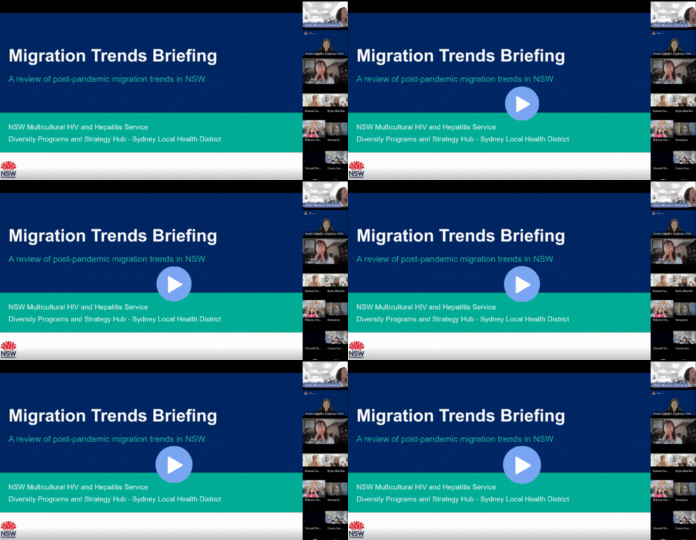
On 3 Dec 2025, 97 participants from the Ministry, Local Health Districts, community services, and multicultural organisations joined our webinar exploring the latest migration trends in NSW — and what they mean for health equity, community engagement, and service planning. The session drew on fresh migration data to provide actionable insights for health services, highlighting how new arrivals, visa-holders, asylum-seekers, international students, and temporary workers often face barriers to care, particularly for sensitive conditions like HIV, hepatitis, or STIs. Presenters shared strategies for culturally safe, multilingual, and low-barrier health services to improve prevention, reduce stigma, and support long-term community health.

The webinar featured three powerful presentations followed by a lively Q&A. The full session and slide decks are now available for download.

Presenter Overview & Key Takeaways

Presenter(s) Organisation Materials Available Key Takeaways
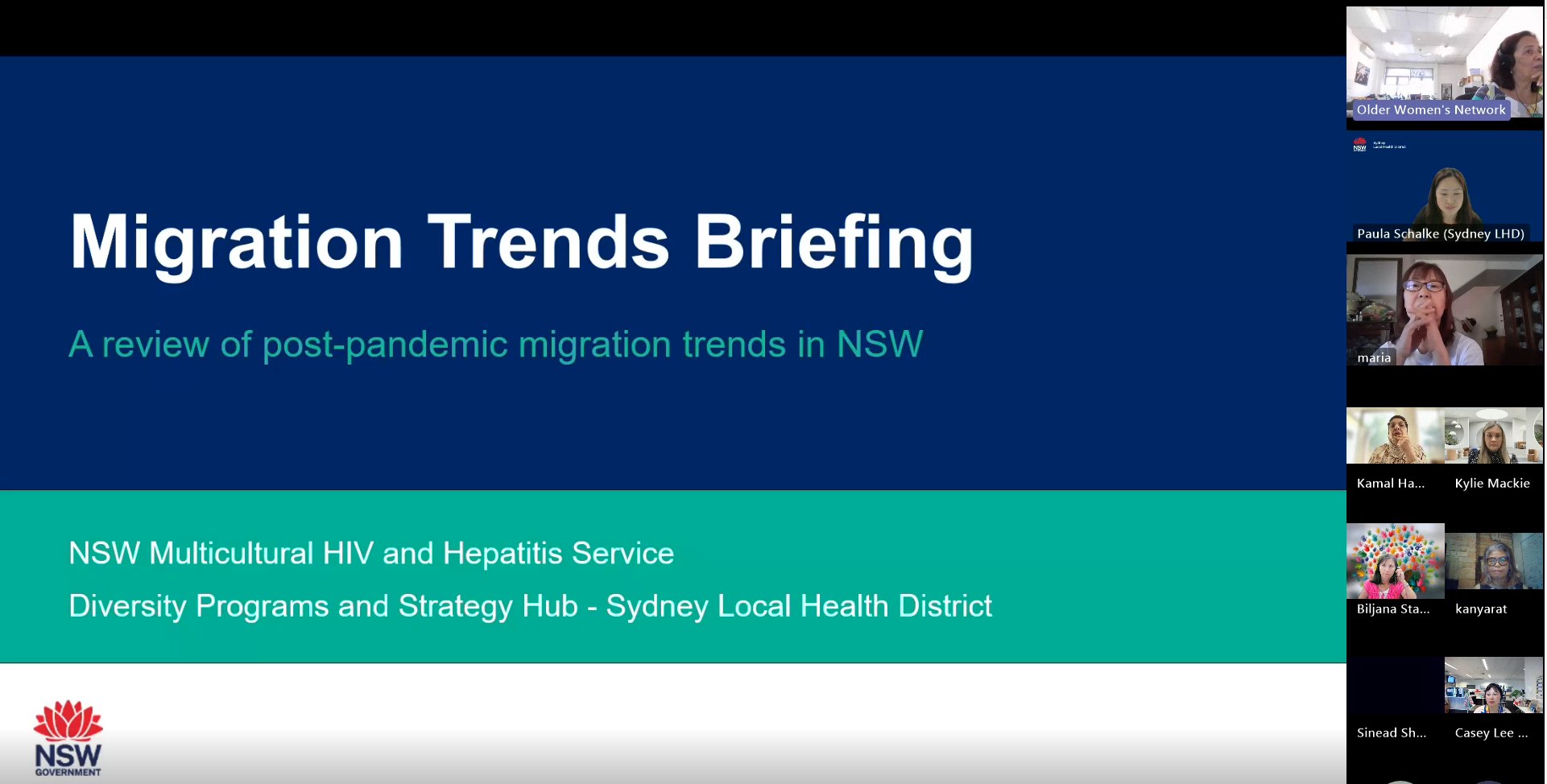
Paula Schalke MHAHS – Multicultural HIV and  Hepatitis Service Download Slide Deck (PDF) Overseas migration drove ~80% of NSW’s population growth in 2023–24. Migrants now come from more diverse regions — Southern/Central Asia, Africa, Middle East, Latin America — increasing demand for culturally appropriate, multilingual health services, especially for BBV/STI prevention and care.
Kylie MacKie Asylum Seekers Centre Download Slide Deck (PDF) Many asylum-seekers face barriers (no Medicare, language, cost, stigma). The centre provides nurse-led clinics, pro-bono GPs, referral support, and essential social services. Flexible, community-centred care is vital for health equity.
Mal Fruen OAM & Tarek Koroisamanunu NSW Council for Pacific Communities Download Slide Deck (PDF) PALM scheme Pacific workers often lack stable visas or health access, face social isolation and financial stress. Culturally safe outreach, health access advocacy, and community-led support for physical and mental health are critical, especially in regional areas.

Watch the full 'Migration Trends' webinar (3 Dec 2025) - Click the links below to view. 
For NSW Health Staff (NSW Health email required):
Watch on SharePoint (internal access)

For community members and external partners:

Watch on Google Drive (open access)

    Additional Resources

    • MHAHS NSW Post-Pandemic Migration Analysis Report 2025 [Download report here]
    • NSW STI Data Report 2024 [Download report here]
    • HIV – What You Need to Know (multilingual booklet) — [Visit Resource Page here]
    • Are You Living with Hepatitis B? campaign resources — [Visit Resource  Page here]
    • NSW Council for Pacific Communities — [Visit Website here
    • Asylum Seekers Centre — [Visit Website here]

    World AIDS Day 2025: Rethink. Rebuild. Rise — Together for All Communities

    This World AIDS Day, communities across NSW are invited to raise awareness and share the global message: Rethink. Rebuild. Rise, alongside Australia’s theme: No One Left Behind.

    We encourage everyone to:
    •    Rethink how we talk about HIV
    •    Rebuild trust in testing and healthcare
    •    Rise above fear, stigma and misinformation

    HIV is treatable, and with early testing and access to care, people living with HIV can live long, healthy lives. But stigma and silence still prevent many from getting tested or seeking help.

    That’s why World AIDS Day is so important — it’s a time to share facts, support each other, and ensure no one is left behind.

    'We want everyone, in every community, to feel informed and supported,' said Shih-Chi Kao, Manager of the Multicultural HIV and Hepatitis Service (MHAHS).

    What You Need to Know
    •    HIV treatment is free in NSW, even without a Medicare card
    •    Free HIV self-testing options are available, including MyTest and Dried Blood Spot Testing
    •    Multilingual resources and bilingual support are available to help navigate care

    Explore the MHAHS website to:
    •    Access HIV information in your language
    •    Learn about testing options
    •    Find support through the HIV Clinical Concierge Program
    •    Download resources like HIV: What You Need to Know and 7 Good Reasons to Test for HIV

    Support Your Community
    MHAHS offers in-language education sessions for community groups and media outlets. These sessions help communities rethink what we know about HIV, rebuild trust in care, and rise above stigma.

     To organise a session or request a media interview, contact:
     Sonam Paljor
     Phone: (02) 9515 1234
     Email: This email address is being protected from spambots. You need JavaScript enabled to view it.

    Healthy Ageing for People Living with HIV – Multicultural Health Week 2025

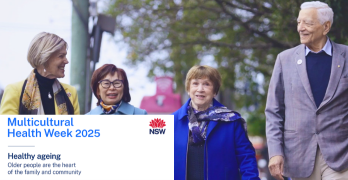
    Multicultural Health Week (1–7 September) celebrates the strength and contributions of older people in our diverse communities. In NSW, people living with HIV are living longer, healthier lives thanks to effective HIV medications. But as people age, they may face health issues earlier — including conditions not directly linked to HIV.

    Healthy ageing is about more than just medical care. It includes mental wellbeing, staying socially connected, and understanding how to manage other chronic conditions such as hepatitis B.

    This year, we’re highlighting resources that support older people, including:

    Free interpreter-assisted coaching via the Get Healthy Service: https://www.gethealthynsw.com.au/ 

    These resources are part of a broader effort to ensure that older adults — especially those living with HIV or hepatitis B — are empowered to manage their health, access culturally appropriate services, and stay active and informed.

    To stay-up-to-date with the latest information, follow our Facebook page www.facebook.com/theMHAHs

    Hepatitis Awareness Week 2025: Join the Call to Eliminate Hepatitis B and C by 2030 


    Hepatitis Awareness Week (28 July to 3 August, 2025) and World Hepatitis Day (28 July) are fast approaching, shining a spotlight on the urgent need to address hepatitis B and C in our communities.  

    In response, NSW Multicultural HIV and Hepatitis Service (MHAHS) is leading a campaign to raise awareness about liver health and promote access to testing and treatment—especially in culturally and linguistically diverse (CALD) communities. The campaign supports Australia’s national goal to eliminate viral hepatitis as a public health threat by 2030. However, experts warn that current progress is too slow to meet this target. The time to act is now. 

    Multilingual resources, free education sessions and webinar 

    Our campaign features a multilingual toolkit which brings together a wide range of free, in-language resources, including posters, brochures, videos, and social media content in Arabic, Chinese, Korean, Samoan, Tongan, Nepali, Mongolian, Khmer, Vietnamese and more. 

    Community groups in the Sydney Local Health District can also book free education sessions with us on hepatitis B and hepatitis C, available in multiple languages and tailored to local communities. 

    As part of the campaign, community and health workers are invited to attend a free online webinar, The ABC of Liver Health. This informative session will cover the basics of hepatitis B and C, the importance of liver health, and how to support testing and care—especially within CALD communities. The webinar is a valuable opportunity to build awareness, ask questions, and access practical, multilingual resources that can be shared with local communities. 

    <Register here>. 

    How you can help 

    •     Promote testing: Encourage community members to speak with their GP about hepatitis B and C testing. 
    •     Share resources: Download and distribute multilingual materials from the toolkit. 
    •     Host a session: Contact MHAHS to organise a free education session for your community. 

    You can access the Hepatitis Awareness Week 2025 Multilingual Toolkit here

    Together, we can take action to prevent liver cancer, improve health outcomes, and help eliminate hepatitis B and C by 2030. 

    For media interviews, to organise an education session, join the webinar, or request more information, please contact NSW MHAHS on (02) 9515 1234 or email This email address is being protected from spambots. You need JavaScript enabled to view it..